Render archives as HTML, PDF, and image files Leave feedback
On this page
GroupDocs.Viewer for Python via .Net allows you to view the contents of archive files in HTML, PDF, PNG, and JPEG formats. You do not need to use third-party file archiver and compression software to display archive file contents within your .NET application (web or desktop).
To start using the GroupDocs.Viewer API, create a Viewer class instance. Pass an archive file you want to view to the class constructor. You can load the archive from a file or stream. Call one of the Viewer.view method overloads to convert the archive file to HTML, PDF, or image format.
GroupDocs.Viewer supports the following archive file formats:
- .7Z (7-Zip Compressed File)
- .BZ2 (Bzip2 Compressed File)
- .GZ (Gnu Zipped Archive)
- .RAR (WinRAR Compressed Archive)
- .TAR (Consolidated Unix File Archive)
- .TGZ / .TAR.GZ (Gzipped Tar File)
- .TXZ / .TAR.XZ (XZ Compressed Tar Archive)
- .XZ (XZ Compressed Archive)
- .ZIP (Zipped File)
GroupDocs.Viewer can detect the archive file format automatically based on information in the file header.
To convert an archive file to HTML, call the HtmlViewOptions.for_embedded_resources method to create an HtmlViewOptions class instance and pass this instance to the Viewer.view method.
from groupdocs.viewer import Viewer
from groupdocs.viewer.options import HtmlViewOptions

def render_archive_to_html():
    # Load archive file
    with Viewer("documents.zip") as viewer:
        # Create an HTML file for the top folder and each subfolder in the archive.
        # {0} is replaced with the current page number in the output file name.
        viewOptions = HtmlViewOptions.for_embedded_resources("render_archive_to_html/pdf_page_{0}.html")
        viewer.view(viewOptions)

if __name__ == "__main__":
    render_archive_to_html()
documents.zip is the sample file used in this example. Click here to download it.
HTML file (73 KB)
If you need to display the contents of an archive file on a single HTML page, enable the HtmlViewOptions.render_to_single_page option, as shown below:
from groupdocs.viewer import Viewer
from groupdocs.viewer.options import HtmlViewOptions

def render_archive_to_single_html():
    # Load archive file
    with Viewer("documents.zip") as viewer:
        # Create an HTML file.
        viewOptions = HtmlViewOptions.for_embedded_resources("render_archive_to_single_html/archive_to_single_html.html")
        # Render the archive file to a single page.
        viewOptions.render_to_single_page = True
        viewer.view(viewOptions)

if __name__ == "__main__":
    render_archive_to_single_html()
documents.zip is the sample file used in this example. Click here to download it.
HTML file (73 KB)
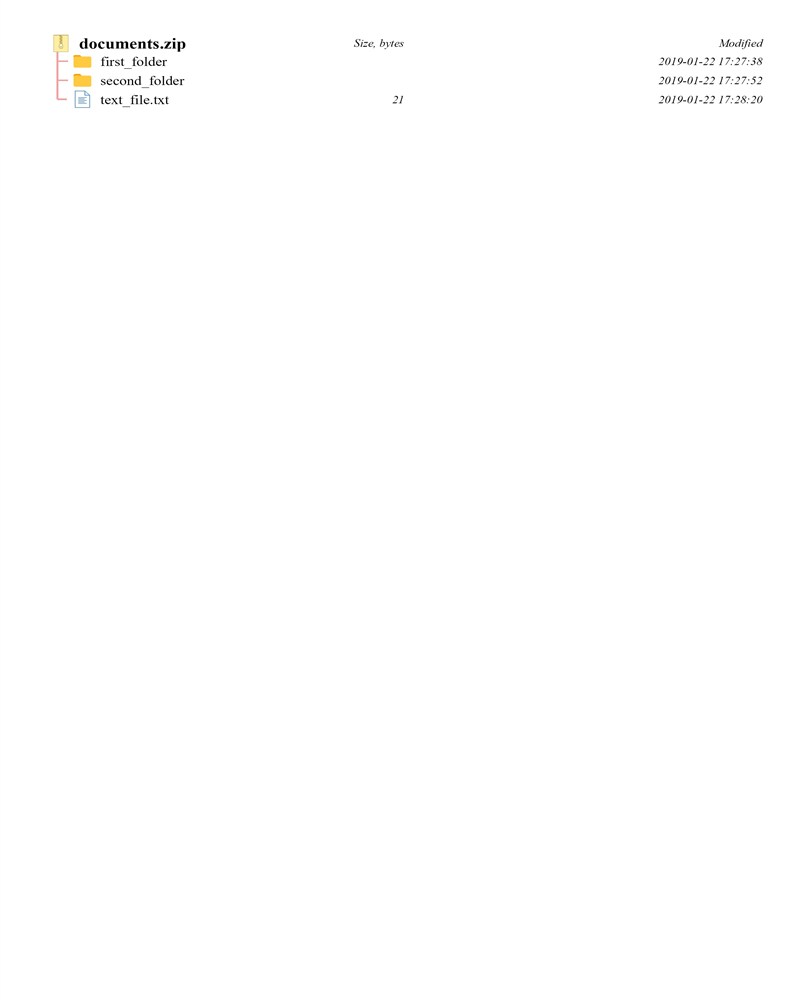
You can navigate between the archive folders. Click on a particular folder to see its contents. To go backward, click the required folder name in the navigation bar at the top of the web page.
Create a PdfViewOptions class instance and pass it to the Viewer.view method to convert an archive file to PDF. The PdfViewOptions class properties allow you to control the conversion process. For instance, you can protect the output PDF file or reorder its pages. Refer to the following documentation section for details: Rendering to PDF.
from groupdocs.viewer import Viewer
from groupdocs.viewer.options import PdfViewOptions

def render_archive_to_pdf():
    # Load archive file
    with Viewer("documents.zip") as viewer:
        # Create a PDF file.
        viewOptions = PdfViewOptions("render_archive_to_pdf/archive_content.pdf")
        viewer.view(viewOptions)

if __name__ == "__main__":
    render_archive_to_pdf()
documents.zip is the sample file used in this example. Click here to download it.
Binary file (PDF, 81 KB)
Create a PngViewOptions class instance and pass it to the Viewer.view method to convert an archive file to PNG. Use the PngViewOptions.height and PngViewOptions.width properties to specify the output image size in pixels.
from groupdocs.viewer import Viewer
from groupdocs.viewer.options import PngViewOptions

def render_archive_to_png():
    # Load archive file
    with Viewer("documents.zip") as viewer:
        # Create a PNG image for the top folder and each subfolder in the archive.
        # {0} is replaced with the current page number in the image name.
        viewOptions = PngViewOptions("render_archive_to_png/archive_page_0_{0}.png")
        # Set width and height.
        viewOptions.width = 800
        viewOptions.height = 1000
        viewer.view(viewOptions)

if __name__ == "__main__":
    render_archive_to_png()
documents.zip is the sample file used in this example. Click here to download it.
Binary file (PNG, 104 KB)
Create a JpgViewOptions class instance and pass it to the Viewer.view method to convert an archive file to JPEG. Use the JpgViewOptions.height and JpgViewOptions.width properties to specify the output image size in pixels.
from groupdocs.viewer import Viewer
from groupdocs.viewer.options import JpgViewOptions

def render_archive_to_jpg():
    # Load archive file
    with Viewer("documents.zip") as viewer:
        # Create a JPEG image for the top folder and each subfolder in the archive.
        # {0} is replaced with the current page number in the image name.
        viewOptions = JpgViewOptions("render_archive_to_jpg/archive_to_jpg_{0}.jpg")
        # Set width and height.
        viewOptions.width = 800
        viewOptions.height = 1000
        viewer.view(viewOptions)

if __name__ == "__main__":
    render_archive_to_jpg()
documents.zip is the sample file used in this example. Click here to download it.
Binary file (JPG, 84 KB)
When you convert an archive file to HTML, PDF, or image format, GroupDocs.Viewer renders items from all folders contained in the archive. If you need to render items from a specific folder, specify the ArchiveOptions.folder property for one of the following classes (depending on the output file format):
from groupdocs.viewer import Viewer
from groupdocs.viewer.options import HtmlViewOptions

def render_specific_archive_folder():

    # Load archive file
    with Viewer("documents.zip") as viewer:
        # Create an HTML file.
        viewOptions = HtmlViewOptions.for_embedded_resources("render_specific_archive_folder/specific_archive_folder.html")
        viewOptions.archive_options.folder = "Invoices"
        viewer.view(viewOptions)

if __name__ == "__main__":
    render_specific_archive_folder()
documents.zip is the sample file used in this example. Click here to download it.
HTML file (13 KB)
When rendering an archive file, GroupDocs.Viewer displays the archive file name in the header of each page. If you need to change or hide this name, define the archive_options.file_name property for a target view. You can set this option to one of the following values:
- FileName.SOURCE— Returns the name of the source file (this name is used by default).
- FileName.EMPTY—Specifies an empty name. Use this value to hide the archive file name in the output file.
- A FileName instance with a custom name you want to display in the output file.
The following code snippet demonstrates how to use a custom name when rendering an archive file to HTML:
from groupdocs.viewer import Viewer
from groupdocs.viewer.options import HtmlViewOptions, FileName

def render_archive_with_custom_filename():
    # Load archive file
    with Viewer("documents.zip") as viewer:
        # Create an HTML file for the top folder and each subfolder in the archive.
        # {0} is replaced with the current page number in the output file name.
        viewOptions = HtmlViewOptions.for_embedded_resources("render_archive_with_custom_filename/archive_with_custom_filename_{0}.html")
        # Specify a custom filename
        viewOptions.archive_options.file_name = FileName("Sample Files")
        viewer.view(viewOptions)

if __name__ == "__main__":
    render_archive_with_custom_filename()
documents.zip is the sample file used in this example. Click here to download it.
HTML file (73 KB)
Was this page helpful?
Any additional feedback you'd like to share with us?
Please tell us how we can improve this page.
Thank you for your feedback!
We value your opinion. Your feedback will help us improve our documentation.