Compare documents Leave feedback
On this page
GroupDocs.Comparison detects changes in text (paragraphs, words, characters), tables, images, and shapes across a wide range of formats — Word, PDF, Excel, PowerPoint, HTML, AutoCAD, Visio, Outlook, OpenDocument, images, and more. The full list is available on the Supported document formats page.
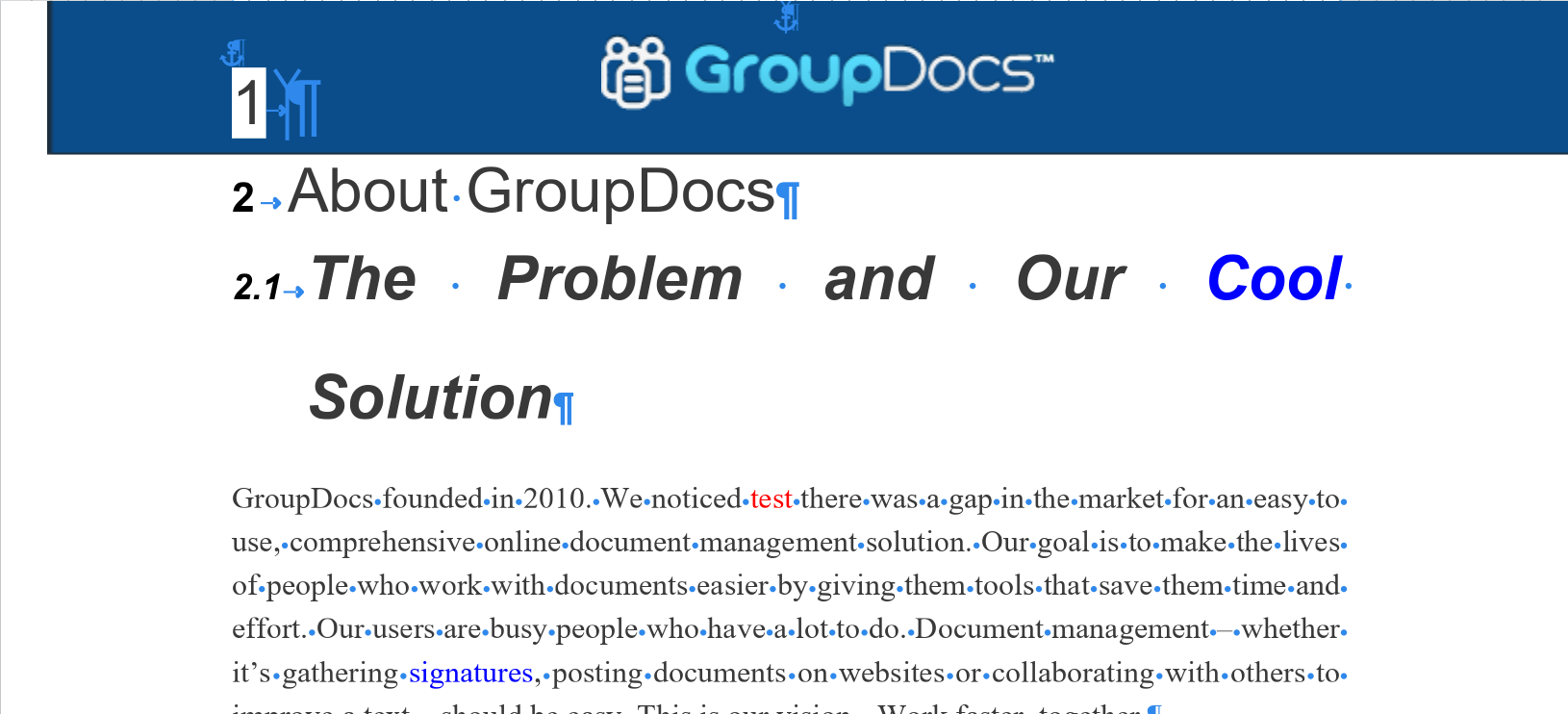
By default, GroupDocs.Comparison highlights detected changes with the following colours:
- Inserted – blue
- Deleted – red
- Style changed – green
These are the defaults — you can override colours, fonts, and other styling via the InsertedItemStyle, DeletedItemStyle, and ChangedItemStyle properties. See Customize changes styles for details.
To compare two documents, follow these steps:
- Instantiate the Comparer object with the source document path or stream.
- Call the Add method and specify the target document path or stream.
- Call the Compare method.
using GroupDocs.Comparison;
// ...

using (Comparer comparer = new Comparer("source.docx"))
{
    comparer.Add("target.docx");
    comparer.Compare("result.docx");
}
The output file is as follows:
using GroupDocs.Comparison;
using System.IO;
// ...

using (Comparer comparer = new Comparer(File.OpenRead("source.docx")))
{
    comparer.Add(File.OpenRead("target.docx"));
    comparer.Compare(File.Create("result.docx"));
}
To control how the comparison is performed and how the result is rendered, pass a CompareOptions object to the Compare method. These options work with any supported document format:
using GroupDocs.Comparison;
using GroupDocs.Comparison.Options;
// ...

using (Comparer comparer = new Comparer("source.docx"))
{
    comparer.Add("target.docx");

    CompareOptions options = new CompareOptions
    {
        DetectStyleChanges = true,
        GenerateSummaryPage = true,
        ShowDeletedContent = true,
        ShowInsertedContent = true
    };

    comparer.Compare("result.docx", options);
}
For format-specific behaviour, GroupDocs.Comparison provides dedicated subclasses of CompareOptions:
- WordCompareOptions — Word-specific settings such as
DisplayMode(Revisions / Highlight), header/footer comparison, and bookmark comparison. See Word document comparison options. - PdfCompareOptions — PDF-specific settings such as
DisplayMode(Inline / SideBySide / Interleaved), page-range filtering, and PDF annotation author name.
Using a format-specific subclass is recommended when comparing a known document type — it makes Word-only or PDF-only settings discoverable and prevents you from passing irrelevant options.
While CompareOptions controls how documents are compared, LoadOptions controls how the source and target files are loaded into the Comparer. It is passed to the Comparer constructor and to Add, before any comparison runs.
using GroupDocs.Comparison;
using GroupDocs.Comparison.Options;
// ...

LoadOptions loadOptions = new LoadOptions
{
    FileType = FileType.DOCX
};

using (Comparer comparer = new Comparer("source.docx", loadOptions))
{
    comparer.Add("target.docx", loadOptions);
    comparer.Compare("result.docx");
}
Common LoadOptions properties:
Password— open a password-protected source or target document. See Load password-protected documents.FileType— specify the document format explicitly and skip auto-detection (faster for large files). See Specify file type for comparison manually.FontDirectories— provide custom font directories used while rendering the result. See Load custom fonts.
Once the basic comparison works, common follow-up tasks include:
- Customize changes styles — change highlight colours, fonts, and formatting.
- Adjusting comparison sensitivity — tune how granular the comparison should be.
- Get list of changes — retrieve detected differences as a structured collection.
- Accept or reject detected changes — apply changes selectively.
- Compare multiple documents — compare more than two files in a single pass.
- Load password-protected documents — provide passwords for protected source or target files.
Was this page helpful?
Any additional feedback you'd like to share with us?
Please tell us how we can improve this page.
Thank you for your feedback!
We value your opinion. Your feedback will help us improve our documentation.